Another way to read the whole Bible in 2014

Dusty BibleOver the last couple of days, I’ve put together a simple Bible reading plan to get me through the Bible in a year. It was really just designed for my own use, so it’s tailored to what I want from a Bible reading plan. But I thought it was worth sharing in case it helps anyone else.

Why another Bible reading plan when there are so many out there (see below)? What makes this one different? Basically, I wanted something that would allow me to get through the Bible by concentrating on one book at a time (rather than reading a single chapter from multiple books each day). I also wanted something that deliberately did NOT start at Genesis and end at Revelation, but rather moved around from genre to genre throughout the year (blame YouTube for ruining my attention span, but I think this method has a better chance of keeping me engaged throughout the year).

Here is a PDF of my plan (Colour-coded Version | Black & White Version) Continue reading

Book Reviews: Crazy Busy by Kevin DeYoung, plus the best of 2013

If you’re looking to put together a summer reading list, here are five ideas to get you started. These are some of the best books I’ve read in 2013. Enjoy!

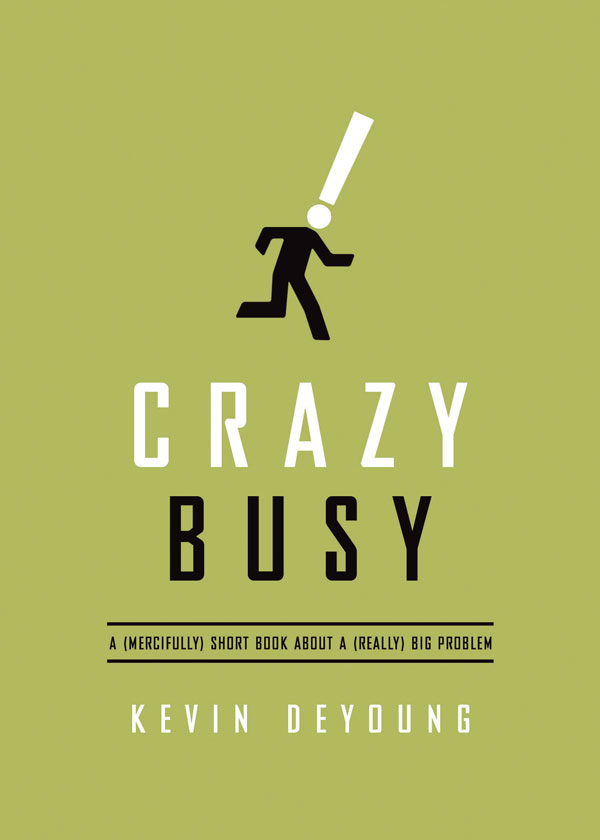
Book Cover - Crazy BusyCrazy Busy by Kevin DeYoung (Hard copy | eBook)
Kevin DeYoung is one of my favourite Christian writers, mostly because his books are thoroughly biblical. He refuses to use Scripture superficially, but digs deeply and carefully into the riches of the Bible in all his books. In doing so, he helps you see how to handle the Bible for yourself. On top of that, he is just a flat-out good writer, particularly because he gets that clarity (not obscurity) is a virtue for anyone wanting to expound the Bible and help people to understand the things of God.

The title of his latest book, Crazy Busy: A (Mercifully) Short Book About a (Really) Big Problem, probably grabs your attention without much help. If you don’t know what it is to feel crazy busy, then rejoice and be glad – and skip this book. But if you’re among the other 95% of the population, then it’s absolutely worth your time. DeYoung doesn’t just dig through the Bible to find some self-help bromides to aid us in our busyness. Instead, he goes back to basics, addressing the theological roots of why our lives feel so manic, yet managing to apply his findings to real-life situations like parenting, setting good priorities, and monitoring your use of technology. The publishers have also produced some excellent resources at crazybusybook.com (including a study guide) which will help book clubs or staff teams wanting to read the book together. Continue reading

The Top Ten of 2013

Top TenIt’s that time when, apparently, bloggers post ‘best-of’ lists from the year that’s past. So here we go. These are the top ten most viewed posts from Every Thought Captive in 2013.

10. A Breaking Bad Idea: I took some heat (some of it justified) for this rumination on whether or not Christians should watch shows like Breaking Bad. I’m glad it raised questions for people.

9. Depression and the Christian: A collection of resources for people dealing with (or helping those dealing with) this massive issue. Continue reading

Accepting the foolishness of Christian faith

Light Bulb HeadThis week, researchers at the University of Rochester have made a slightly off-putting discovery. Trawling back through decades of studies, they believe they have found “a reliable negative relation between intelligence and religiosity.” That is, they believe they’ve worked out that atheists are smarter than religious people.

The research looked at 63 studies conducted between 1928 and 2012, and found that 53 studies showed this ‘reliable negative correlation’ between religion and intelligence. Out of those 53, no less than 35 were said to demonstrate a ‘significant’ negative correlation. Continue reading

Why David Cameron owes Jesus £1 million

Britain Prime MinisterIn the past week, in preparation for an upcoming talk, I went looking for information on what people consider to be the world’s single biggest problem. During my research, I stumbled across this fascinating story: British Prime Minister David Cameron has promised to award £1 million to anyone who can discover the world’s biggest problem – and solve it. Continue reading

Religious freedom and grace to the vulnerable

Closing doorsOver the weekend, The Sydney Morning Herald posted this article about a bid to overturn NSW laws “allowing private schools to expel students simply because they are gay”.

You can read the article for yourself, but one of the key points it raised was the threat to freedom of religion and ethos for the schools in question. It’s a real issue – one to which I’m extremely sympathetic, and one that requires serious, ongoing thought in countries like New Zealand and Australia.

However, that’s not the only thing that caught my attention. As I read the article, I wondered: Why would any Christian school turn away a student solely because of that student’s sexuality? Continue reading

Carl Trueman: What Can Miserable Christians Sing?

Carl TruemanYesterday at the TSCF 2013 National Conference, I was reminded of this brilliant article by Carl Trueman (during an equally brilliant talk by Paul Windsor on the Psalms). I very highly recommend anything by Carl Trueman, but this article became something of an instant classic when he first penned it a few years back. It has the arresting title, ‘What Can Miserable Christians Sing?’

You can read the whole article here, but here’s a sample to whet your appetite:

“By excluding the cries of loneliness, dispossession, and desolation from its worship, the church has effectively silenced and excluded the voices of those who are themselves lonely, dispossessed, and desolate, both inside and outside the church. Continue reading

Don Carson on biblical productivity, and surviving intellectual challenges to faith

Ligonier has posted a valuable little interview with Don Carson, with answers packed with biblical insight and practical wisdom. Especially interesting to think through what he has to say about preparing your children for life in university (or for those of us who work in student ministry to consider how these insights might impact the way we minister to young Christians):

Here’s an example: “The most dangerous seedbed for intellectual rebellion is a home where faith is sentimental and even anti-intellectual, and where opponents are painted as ignorant knaves, because eventually our children discover that there are some really nice people who are atheists and agnostics, and they can present arguments in sophisticated, gentle, and persuasive fashion.”

One-Year Bible Reading Plan

With the new year approaching, I started to think about some plans for next year. One thing I decided I’m going to try and do is to read through the whole Bible in 2012. And I’d like to ask if you want to join me.

There are stacks of Bible reading plans out there, but in the end, after looking at a few, I decided to make my own. I’ve just called it the One-Year Bible Reading Plan (loosely based around another plan called the ‘Bible Reading plan for Shirkers and Slackers’ – great name!).

I decided to do my own version, because I wanted a plan that would:

  • Get me through the OT once and the NT twice
  • Allow me to read a variety of biblical books during any given week
  • Allow me to choose what I feel like reading as the year goes along, rather than having every day of the year planned out specifically in advance
  • Not fall apart if I missed a day (which I inevitably will)

The plan I put together is my attempt to do that. Here it is, in case anyone finds it useful.

Other plans work in slightly different ways. Another very well known one is called the ‘M’Cheyne Reading Plan’. This plan gets you through the OT once and the Psalms and NT twice in a year. It spells out exactly what to read on every day of the year. It can be easily adapted to get you through the Bible in two years instead of one (just do two readings each day instead of all four). I wanted something a bit different, but this is an excellent plan. It also has the advantage of an excellent blog by Don Carson which provides a daily reflection to match one of that day’s readings: www.thegospelcoalition.org/blogs/loveofgod

Reading the whole Bible in a year is quite a commitment. Whether or not you’ve ever tried something like this before, I’d really like to encourage you to give it a go. Each day’s reading should only take about 15 minutes on average. I know finding even that much time can be very hard sometimes, but 15 minutes a day is doable, and the benefits will be enormous.